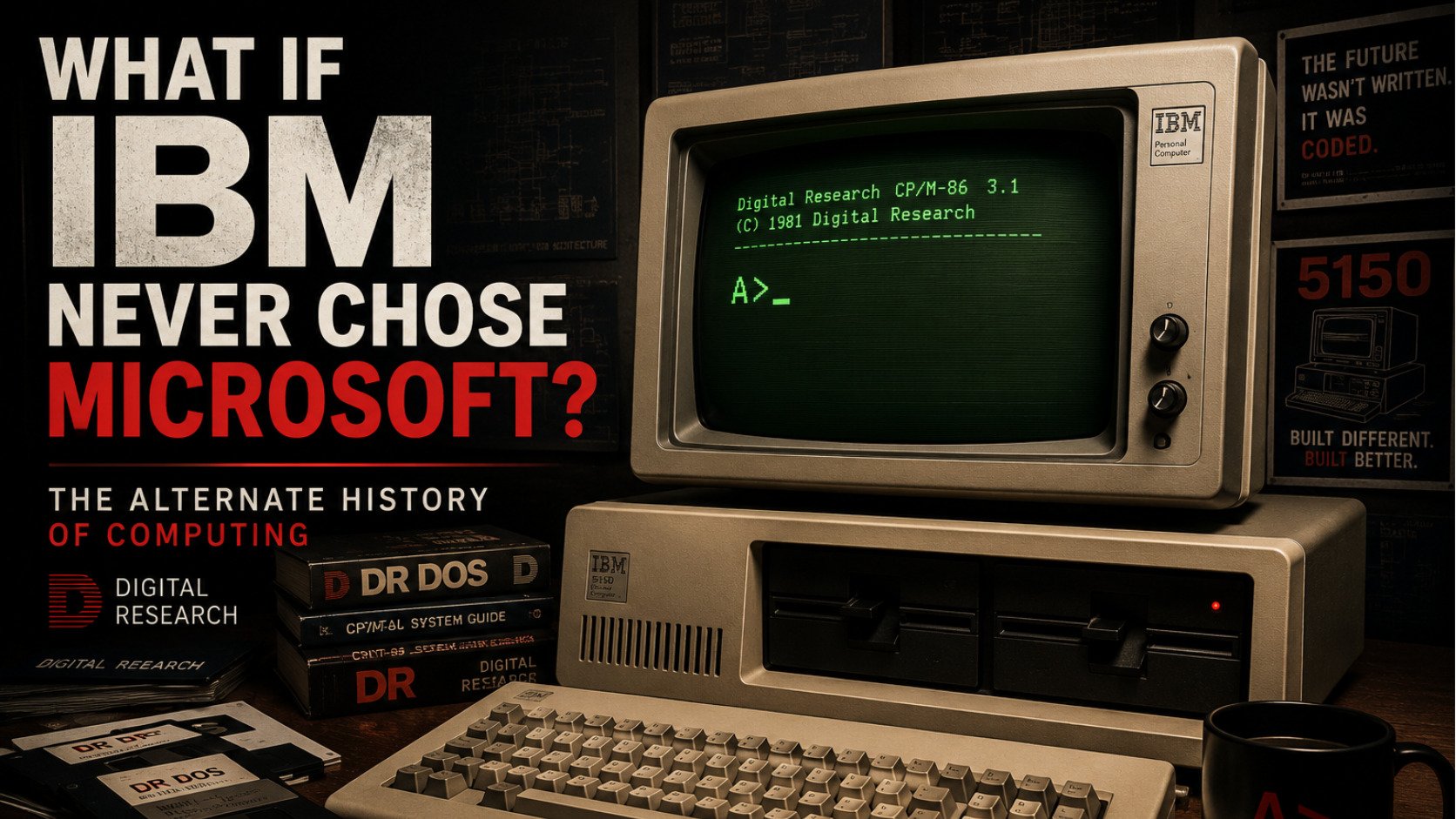
IBM PC with Digital Research CP/M-86 — the operating-system deal that could have rewritten personal computing.
Series: What If? — Episode 03
What If IBM Had NeverChosen Microsoft?
What if IBM had licensed Digital Research's CP/M-86 instead of MS-DOS? One contract could have rewritten the personal computer industry.
▼ SCROLL ▼
How we test the counterfactual
The methodology of the alternate timeline
This is not a wish list of software Digital Research should have written. We start with the code, contracts and market conditions that actually existed between 1980 and 1983, then estimate which branches become reachable if Gary Kildall's company—not Bill Gates'—signs the operating-system contract for the IBM Personal Computer.
The rule is the same one we used for Amiga: a counterfactual is only interesting if the prerequisite already existed. Everything else is fan fiction.
For every milestone we ask four questions: did Digital Research possess the technical prerequisite, could it finance the migration, would developers follow, and did surrounding standards make the product commercially viable?
The documented starting point
The 1980 split
Start with what is documented, because the popular version is mostly wrong. The legend says IBM arrived in Pacific Grove, found Gary Kildall flying his airplane, felt snubbed and returned to Bill Gates. It is a great story—and a caricature.
The real break points were contractual. IBM arrived with a one-sided non-disclosure agreement that Dorothy McEwen would not sign immediately. Microsoft signed IBM's paper without hesitation.
Then came pricing. DRI sold CP/M as a software product with a per-copy margin. Microsoft gave IBM a flat-fee arrangement that let it sell DOS cheaply. When both systems reached the PC, IBM listed PC-DOS at roughly $40 and CP/M-86 at roughly $240.
The decisive clause was non-exclusivity. Microsoft licensed the operating system to IBM and kept the right to license it to everyone else.
And the product itself was not even Microsoft's. It bought Tim Paterson's 86-DOS from Seattle Computer Products, a system explicitly modeled on the CP/M programming interface.
Before DOS became inevitable
The world in 1980
CP/M ran across a vast, chaotic installed base. There was no hardware standard; CP/M was the reason software could travel between machines.
Microsoft in 1980 was a languages company. It had never shipped an operating system.
IBM was building the PC as a Boca Raton skunkworks project, using off-the-shelf components to hit a twelve-month deadline.
The lead history forgets
Digital Research's advantage
Four things DRI actually had that Microsoft did not:
Installed base
The first generation of serious business applications already ran on CP/M.
Abstraction architecture
The BDOS/BIOS separation solved the exact problem the clone era would create.
A multitasking path
MP/M and Concurrent CP/M delivered multitasking years before Microsoft shipped a preemptive consumer system in 1995.
A GUI in progress
GEM shipped in 1985 and was arguably a better desktop than Windows 1.0.
DRI had those four strengths—and lacked two things: an instinct for hardball licensing and a legal war chest.
The weaknesses were real
Technical foundations
Honesty requires listing the weaknesses too, because CP/M's reputation among people who never used it is better than its reputation among people who did.
CP/M-86 was late and still felt like an 8-bit design moved onto a 16-bit processor.
CP/M used user areas until CP/M Plus and split multitasking into a separate product line.
DRI priced like a software vendor selling to integrators. Microsoft priced like an infrastructure vendor buying a market.
One contract, six turning points
The alternate timeline
Assume the NDA is signed in June 1980 and CP/M-86 becomes the reference operating system of the IBM Personal Computer.
CP/M-86 ships with the PC
Software compatibility is not automatic, but WordStar and dBASE arrive in months rather than years.
The clone question
This fork is commercial, not technical: cheap licenses create the clone industry; protected margins stall it.
Concurrent CP/M becomes the differentiator
Multitasking reaches business desktops three to eleven years early and turns PCs into terminal replacements faster.
GEM becomes the PC desktop
The GEM settlement changes because IBM's legal department does not capitulate, starting the PC graphical era years earlier.
The OS/2 problem changes
IBM has no Microsoft defection to fear, but also no partner strong enough to carry the technical load alone.
The bill comes due
Protected memory, networking, a 32-bit kernel and a browser still need financing.
Previous What If?
What If Amiga Survived?
Episode 02 applies the same four-axis method to Commodore and AmigaOS.
Read postFrom most likely to darkest
Five scenarios
The Faithful Port — most likely
DRI signs, ships CP/M-86 and prices it like professional software. The PC still wins, but personal computing reaches the home later and Microsoft becomes Lotus with better management.
The $40 Concession
DRI becomes the platform owner: more open, better documented and technically coherent, but worse marketed and slower to ship.
Concurrent Ascendant
Preemptive multitasking arrives a decade early and avoids the 640K memory-model catastrophe, but the PC stays corporate longer.
The Clone Denial
The x86 world fragments into three or four incompatible ecosystems and the internet arrives about twenty-four months later.
The Absorption
IBM buys the 200-person company. CP/M disappears into SAA/OS/2 and loses the desktop by 1993.
A winner is only half the argument
The other two players: Microsoft and Apple
Microsoft without DOS
Deleting the IBM contract redirects Microsoft. It reaches 1990 smaller, richer than expected and structurally unavoidable.
Applications become the whole strategy. Multiplan runs everywhere, and Microsoft still beats Lotus and WordPerfect after their failed GUI transitions.
Without DOS, Xenix becomes the counterattack and the open-systems war starts five years early.
Apple and the Macintosh with no Windows
Apple gets clearer air until the GEM lawsuit turns into Apple versus IBM.
IBM litigates and probably reaches a cross-license, but removing Microsoft does not fix Apple's margin and engineering problems.
Apple enters the 1990s stronger but still reaches a crisis, while events after 1997 become too distant for this counterfactual to predict.
The variable worth a trillion dollars
Survival mathematics
DRI owned the installed base and developer momentum. Licensing openness was the variable worth roughly a trillion dollars.
Microsoft understood that an operating system was a toll road, and the toll had to be cheap enough that nobody built a bypass.
DR DOS arrived with better memory management, disk compression and a proper task switcher, yet lost to OEM contracts and warning messages that treated rival DOS systems as unsafe.
Better architecture, slower revolution
The paradox
In most branches where Digital Research wins IBM, the personal-computer revolution is slower, smaller and more expensive—and computing is technically better for it.
A DRI-owned PC platform is more coherent, but also more costly, corporate and less ubiquitous.
The counterfactual deletes a monopoly. It does not delete the monopolist.
Gary Kildall deserves better than the airplane joke.
The surviving-lineage branch
CP/M in 2026
Extrapolate scenario ② forward forty-five years and the operating system has a recognizably different character.
Interactive concept
CP/M 2026 — Integrator Edition
Choose a machine target inside the interface. The BDOS core and desktop remain unchanged while only the board pack adapts—the portability argument made visible.
Abstraction as doctrine
The OS is designed for portability from the start, with a clean separation between kernel and machine layer.
A licensing model instead of lock-in
An embedded and appliance-first OS also runs desktops, rather than the reverse.
Documentation as a first-class product
DRI manuals expect users to program the machine; that norm remains a first-class part of the product.
A much stronger Unix
Free Unix does not spend a decade on the margins; it already wins quietly in 1996.
Quick answers
Q&A
Did IBM really approach Digital Research first?
Yes. The meeting happened and negotiations continued.
Was CP/M-86 available for the IBM PC?
Yes, but IBM's price for it was roughly six times the price of PC-DOS.
Would Microsoft have disappeared without DOS?
Unlikely. Its tools, applications and Xenix gave it several strong paths.
Sources and limits
How we built this
The source base includes Kildall's memoir excerpts, Paterson's 86-DOS accounts, DRI manuals and 1981–1985 price lists, IBM technical references and the unusually rich OEM licensing trial record.
Where the historical record is disputed, we say so instead of choosing the more entertaining version.
Scenario probabilities are editorial judgment, not simulation.
Series: Episode 01: Rome. Episode 02: Amiga. Episode 03: IBM & CP/M.
Platforms do not lose on merit. CP/M did not lose because it was worse than 86-DOS. It lost on pricing, licensing and distribution.
In a network-effect market, the pricing decision is the architecture decision.
Somebody at Digital Research read an unreasonable non-disclosure agreement in the summer of 1980 and objected. They were right. It cost them everything.
Comments
Your turn
Would a technically better but more expensive CP/M world have been worth delaying the personal-computer revolution?