How we built this
The methodology of the alternate timeline
This is not a list of products we wish Commodore had made. We start with the hardware, software and market conditions that really existed in 1994, then estimate which branches become reachable if Amiga receives capital, stable ownership and time.
The Four Axes of the Analysis
For every milestone, we ask the same question: did Amiga already possess the technical prerequisite, could the company finance the migration, would developers follow, and did the surrounding standards make the product commercially viable?
⚙ Existing technical base
Custom graphics and audio chips, preemptive multitasking, genlock and a mature creative-software culture were already real.
💰 Capital and management
Technology only survives if manufacturing, marketing and product planning survive.
👥 Developer momentum
Users attract software and software attracts users.
🔗 Dependency chains
A modern Amiga needs more than a fast CPU.
The result is not an exact prediction. It is a reasoned range.
The starting point
The year 1994 changed everything
On April 29, 1994, Commodore announced voluntary liquidation and bankruptcy proceedings.
Our point of divergence is deliberately small.
Amiga did not need a miracle in 1994. It needed money, one product roadmap and enough time to reach the internet era.
The real machine before the alternate history
The world in 1994
By the early 1990s, Amiga combined capabilities that many mainstream PCs still needed extra hardware or money to match.
⚡ Responsive multitasking
Preemptive multitasking made several applications feel alive at once.
🎨 Dedicated graphics hardware
Custom chips handled display and animation.
🎵 Stereo digital audio
Digital sound was part of the platform's identity.
🧩 Multimedia architecture
Graphics, sound and genlock worked as one production environment.
🖥️ Efficient operating system
AmigaOS delivered a fast graphical workflow with low overhead.
📺 Affordable video production
Broadcast-style tools reached smaller studios and independent creators.
The problem was not that the machine lacked a purpose. The problem was the business behind it.
Amiga's advantage was the complete multimedia experience.
What already existed
Three advantages worth saving
Amiga was not an unfinished idea waiting for future engineers.
🎬Creative credibility
Video Toaster, LightWave and genlock gave Amiga a real place in production.
🧠Efficient operating system
Preemptive multitasking and a responsive interface ran on modest hardware.
🎮Graphics and sound DNA
Custom chips made multimedia part of the machine's architecture.
The weakness was equally real.
The foundation for survival
Two systems that could carry the future
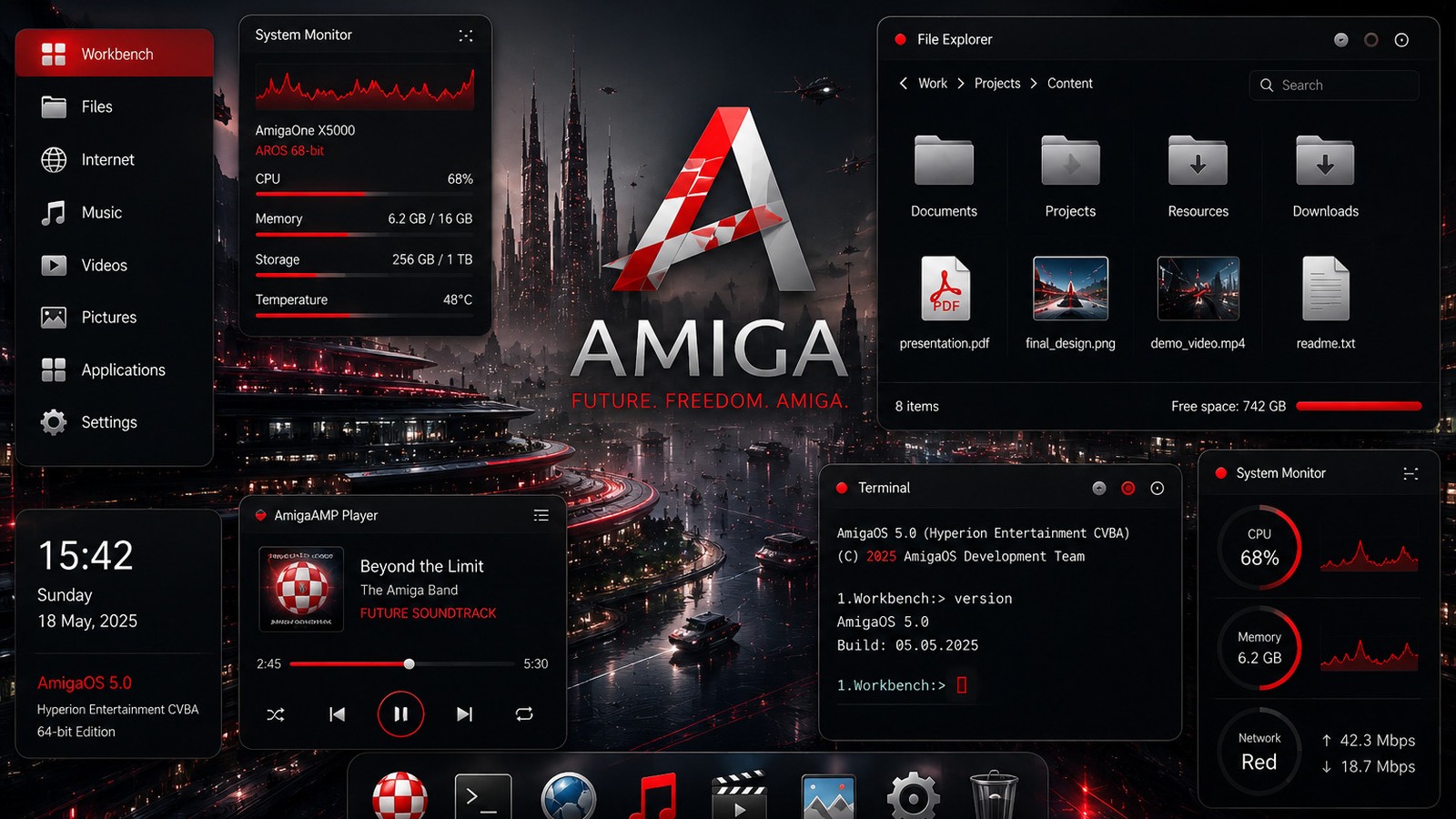
AMIGAOS 2026 — A fictional interface built around the platform's original priorities.
🖥️PowerPC and modern graphics
A funded transition could pair PowerPC processors with standardized graphics cards.
Estimated window: coordinated PowerPC workstation, 1996–1997
🌐Networking and the web
TCP/IP, USB, a modern filesystem and a competitive browser decide whether Amiga enters the broadband home.
Estimated window: internet-ready AmigaOS, 1998–1999
Likely scenario
The timeline that could have been
The sequence matters more than any exact date.
1994
Rescue and product reset
Investors acquire Amiga intact.
Real history: Commodore liquidates.
1996
PowerPC Amiga workstation
A professional machine targets video, 3D and music.
Real history: third parties develop PowerPC accelerators.
1999
Broadband-ready AmigaOS
USB, TCP/IP, browsers and 3D APIs modernize the platform.
Real history: Windows and Mac consolidate the consumer internet.
2002
The creative third platform
Amiga holds meaningful share in creative computing.
2005
Selected native games survive
Selected studios still ship Amiga versions.
2010
ARM and compact Amiga devices
The platform expands into compact devices.
2026
A living third ecosystem
Amiga remains a distinct commercial platform.
What the timeline changes
Five futures branching from one rescue
The dates describe the platform; these scenarios describe the industries around it.
01Amiga becomes the creative computer
Amiga focuses on video, music, animation, broadcasting, games and design.
02Gaming competition changes
3D acceleration, engines and online services arrive earlier, creating another active developer ecosystem.
03Operating systems evolve differently
AmigaOS keeps efficiency and responsiveness visible as commercial priorities.
04Affordable multimedia accelerates
More creators are ready to produce digital video before broadband platforms arrive.
05The internet becomes a three-platform race
A timely internet-ready release creates a genuine third desktop choice.
The mathematics of survival
Great technology still needs market momentum
Technology markets are shaped by network effects.
Could Amiga beat Windows?
Windows already had enormous manufacturing, software and business momentum.
Could Amiga become another Apple?
A profitable premium creative platform is the believable victory.
A few additional years do not guarantee success, but reaching the internet boom changes the odds.
What probably would not change
Intel and compatible PCs
Commodity PC economics remain dominant.
Microsoft Office and business
Corporate standards continue to favor Microsoft.
Internet and cloud computing
Global networking advances regardless of one desktop vendor.
Smartphones
Mobile computing still emerges from broader technological forces.
The uncomfortable possibility
The paradox of survival
The rescue could still fail
Saving the company does not fix the company.
Protecting compatibility can make modernization harder.
The best alternate Amiga survives by knowing what not to preserve.
Alternate world
A modern Amiga
The believable 2026 Amiga is not a Windows clone.
⚡Instant, efficient desktop
Fast boot and low overhead remain real features.
🎨Creator-first media tools
Media production defines the premium machines.
🧩Classic software without classic limits
Compatibility lives inside a safe modern architecture.
🔧Hardware with personality
Compact workstations keep a distinct identity.
The platform in daily use
Workbench becomes a modern creative OS
The hardest design challenge is modernization without losing directness.
Scenario: AmigaOS 12 — Creator Edition
1.Workbench:> system status --creative
CPU: ARM64 / 16 cores
Legacy sandbox: 68K + PPC active
Video pipeline: realtime 8K
Boot time: 4.8 seconds
Network: online
Ready.
This interface is fictional. The design goal is the point.

Previous What If?
What If Rome Never Fell?
See how the same four-axis method handles a civilization-scale timeline.
Read postQA
How believable is this future?
Could Amiga survive?
Yes, with capital and disciplined leadership.
Could it beat Windows?
Probably not in business computing.
Would Apple still recover?
Likely yes, with stronger creative competition.
Are the dates exact?
No. They are broad estimates.
▶ Bottom Line — MediaBoxEnt Take
The tragedy of Amiga is not that it was guaranteed to win.
The most believable 2026 is a smaller third ecosystem.
Sometimes history changes because better technology wins.
— Dario · MediaBoxEnt
Comments
Your turn
Would Amiga have pushed Apple and Microsoft forward—or would bad management have killed it a second time?